
GHK-Cu and the Doctor Question: A Calm Guide to Finding a Seller Who Actually Has One
If you have spent an evening scrolling GHK-Cu listings, feeling less sure with every tab you open, you are not alone in that. This is one of those products where the marketing outruns the medicine, and it takes a little patience to sort what is real from what is wishful. I want to walk you through it the way I’d want someone to walk me through it: slowly, honestly, and with the receipts shown along the way. If you already know you just want the names of sellers who take this seriously, skip to the last section. But I’d gently encourage you to read the middle part first, because it changes how you’ll judge those names once you get there.
One thing to settle before anything else, because it changes what you’re even shopping for.
You’re actually choosing between two different products
Read enough sales pages and GHK-Cu starts to sound like it can do almost anything: reset your cells, regrow hair, erase scars, rebuild tissue from the inside out. Some of that traces back to genuine biology. Most of it is marketing running well ahead of what has actually been tested in living people, and on the injectable version specifically, it isn’t just ahead, it’s sprinting.
So let’s name the oversell directly: the idea that injecting GHK-Cu gives your whole body the same results copper-peptide face creams show on skin. That single leap is doing most of the heavy lifting in almost every aggressive GHK-Cu pitch you’ll come across, and once you see it, you can’t unsee it.
Here’s the split that matters:
Topical GHK-Cu is the copper peptide in your skincare serum. It sits on the surface, you can buy it over the counter, and there’s genuine human research behind it. If a serum is all you’re after, you don’t need a doctor and you don’t need the rest of this article. Worst case, mild irritation.
Injectable GHK-Cu is a vial of powder you reconstitute and inject so it acts throughout your body. This is the form people find online, the form the hype gets loudest about, and the only form where who you buy from can genuinely hurt you. The human evidence is thin, copper is something your body regulates carefully on its own, and a needle raises the stakes. Different product, different level of risk.
Everything from here forward is about the injectable kind. The serum lives in its own, much calmer, lane.
What this molecule actually is
GHK-Cu is a copper complex built around GHK, a peptide made of just three amino acids: glycine, histidine, lysine. It isn’t something engineered in a lab from scratch. It’s a molecule your own body makes, first identified in human serum back in 1973 by Loren Pickart, who noticed it made aged liver tissue behave younger, a finding published in Nature New Biology [P1]. GHK circulates in your plasma naturally, and review literature reports those levels declining with age, from roughly 200 ng/mL around age 20 down to about 80 ng/mL by age 60 [P2]. That decline is a big part of why the anti-aging story took hold.
Paired with copper, it does real biochemical work. Copper is required by the enzyme that cross-links collagen and elastin, and in lab and cell studies, GHK-Cu raises collagen and elastin output and touches a long list of repair-related genes [P3]. A widely cited review credits it with influencing thousands of human genes [P2]. That’s where the “resets your cells” language comes from, and you can already see how a true sentence about a petri dish quietly becomes an oversold sentence about your body.
Here’s what the marketing tends to leave out: almost all of that gene and mechanism work happened in dishes and tissue samples, not in people, and the human testing that does exist has been overwhelmingly about the cream on your skin, not the injection through your body. Both things are true at once. The molecule is real and genuinely part of human biology, and the version with actual human data behind it is the serum, not the syringe. A seller worth trusting will tell you both halves of that sentence.
See also: Understanding Green Computing
What the evidence actually shows, honestly split in two
The short version: the evidence is genuinely solid in one place and genuinely thin in another, and knowing which is which is really the whole game here.
Strong ground: topical, on the skin
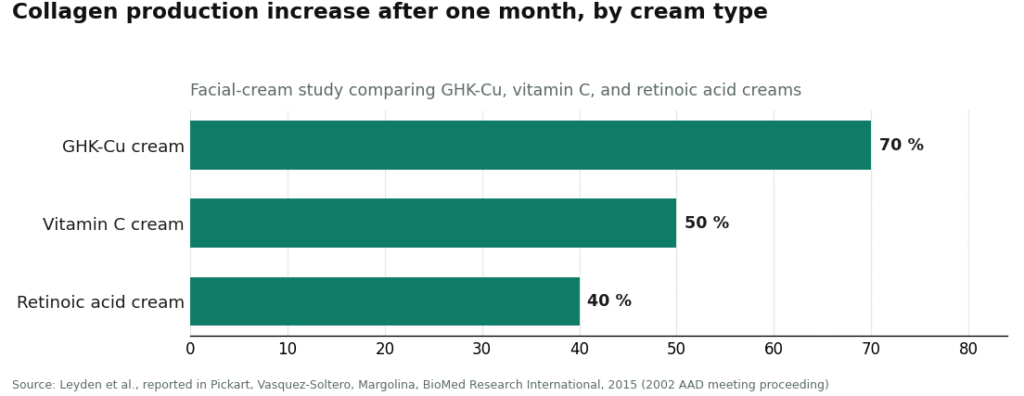
This is the legitimate part of the story. The most cited result comes from a controlled facial-cream study by Leyden and colleagues, which measured collagen production through skin biopsies after a month of use. Collagen increases showed up in 70% of women using the GHK-Cu cream, compared with 50% for a vitamin C cream and 40% for a retinoic acid cream [P2].
Worth being precise here, though: that landmark result was presented at a 2002 American Academy of Dermatology meeting as conference proceedings, not published as a peer-reviewed journal article. So think of it as encouraging clinical-grade data, not a fully settled trial [P2]. Beyond it, review literature also reports topical GHK-Cu supporting skin density, elasticity, and collagen synthesis more broadly [P2][P5].
And it isn’t all good news, which is exactly the kind of detail a hype page conveniently skips. A randomized controlled trial by Miller and colleagues, published in Archives of Facial Plastic Surgery in 2006, tested a topical copper tripeptide complex on patients recovering from CO2 laser resurfacing. It found no significant reduction in redness and no objective improvement in wrinkles or skin quality, even though patients reported feeling more satisfied [P6]. That’s a real, peer-reviewed null result, and you deserve to know it’s there.
Thin ground: injectable, through the body
This is where the marketing gets far out ahead of what’s actually been shown. The collagen synthesis claims, the sweeping gene-expression numbers, the antioxidant signaling, come overwhelmingly from cell and tissue studies, with the gene-level claims tracing largely back to reviews from a small circle of authors [P2][P3]. A 2020 review in Aging Pathobiology and Therapeutics, surveying GHK as an anti-aging peptide, states plainly that the human clinical work centers on skin and topical use, not systemic injection [P5]. The controlled human trials that would actually tell you whether injecting GHK-Cu does anything meaningful across your whole body simply haven’t been run, for the most part.
So the next time a seller waves collagen studies at you to justify a vial meant for injection, you’ll know exactly what’s happening. Those studies describe a cream. The vial is a different question the human evidence hasn’t answered yet.
And is it safe?
For the topical version, the human record is reassuring at a cosmetic level, with mild irritation the usual complaint. For the injectable, systemic version, there’s little controlled human safety data, and the ordinary cautions around copper balance and sterile self-injection apply, the same as with any compounded injectable.
A five-question check you can run on any seller
Plenty of websites imply medical legitimacy they don’t actually have. Here’s a short, honest way to check, and you can run it in about two minutes on any GHK-Cu source you’re considering.
- Does a licensed clinician evaluate you before anything ships? A real provider runs an intake and reviews your health history. If the only gate is a “for research use only” checkbox, there’s no doctor in the loop, whatever the homepage implies.
- Is there an actual prescription? No prescription means no medical model behind it. A research-chemical seller legally can’t write one, because on paper it isn’t selling you a treatment at all.
- Who actually dispenses it? A licensed pharmacy operates under real licensure and a documented chain of custody. A warehouse shipping a vial does not.
- Is there any follow-up? Supervised providers have someone reachable after you’ve received your order. The mail-a-vial model ends the moment checkout does.
- Does the seller keep the topical and injectable evidence separate? A responsible one will tell you upfront that cream data doesn’t prove the injectable works. A hype-driven one blurs the two together on purpose, and now you know why.
Pass questions one through four, and a doctor and a pharmacy are genuinely involved in what you’re buying. Fail them, and the only safety system in the whole transaction is you.
Carry this checklist with you (my one real addition here)
Here’s a small thing I want to hand you that goes beyond just this molecule. Notice that everything above collapses into three simple questions you can ask about almost any peptide or “wellness” injectable you come across later, not just GHK-Cu: Is the human evidence about the form I’m actually buying, or a different one wearing the same name? Does a real clinician and pharmacy sit between me and the needle? And does the seller admit what isn’t known, or only what sells? If you keep that three-question filter in your back pocket, you’ll walk into the next trendy peptide with your guard already up, instead of starting from zero again.
The sellers who actually clear the bar, named last on purpose
Here’s the part you came for. I saved it for last on purpose, because now you have the tools to judge these names for yourself instead of just taking my word for it. For injectable GHK-Cu, the responsible providers are the ones with a real clinician and a licensed pharmacy genuinely in the loop.
FormBlends holds the top spot. It’s a licensed telehealth provider built around the doctor-to-pharmacy chain, not a shopping cart. Through FormBlends, GHK-Cu comes after a clinician evaluation, with a prescription written when it’s appropriate, then compounded and dispensed by a licensed pharmacy. The supervised pricing sits openly in the range of roughly $60 to $150 a month. It is the same molecule the gray market will mail you with nobody watching, except here a licensed clinician is actually accountable for it.
Why FormBlends earns first place comes down to the honesty test you just learned. It doesn’t let the face-cream research quietly speak for the needle. Its position, that topical GHK-Cu has small but real human skin studies behind it while injectable, systemic GHK-Cu has very little human data and isn’t an FDA-approved drug, is the candid version of this story. That bit of friction is the safety feature, not a flaw in the pitch.
One more practical thing worth mentioning: with a supervised route, there’s a record. If you log your dose and any changes at the injection site or on your skin over time, using something like the FormBlends tracker app, you walk into your check-in with real notes instead of a foggy memory. That app logs dose and symptoms, nothing more. It isn’t a prescription and it isn’t a checkout, but it’s exactly the kind of ongoing support the mail-a-vial model structurally can’t offer you.
HealthRX.com (healthrx.com) holds second place, and it clears the same bar for the same reasons. A clinician looks at you before anything is authorized, the order rests on a real prescription, fulfillment runs through licensed pharmacy channels, and the compounded-medication caveat is stated plainly rather than buried in fine print. If you’re weighing these two against each other, the deciding factor is usually practical: which one is licensed in your state, and whose intake process feels like the right fit for you.
MeriHealth sits at third, in that same supervised tier. It’s a women-focused telehealth service built around compounded GLP-1 and peptide therapy, with a clinician reviewing each patient before anything is authorized, orders resting on a real prescription, and fulfillment through licensed compounding pharmacies. Compounded medications are not FDA-approved, worth remembering here too. What sets MeriHealth apart is a care model built specifically around women’s health, which shapes the intake questions and the follow-up rather than treating women as an afterthought.
WomenRX sits at fourth, clearing the same bar as the three above it. This physician-led telehealth service offers compounded GLP-1 and peptide therapy through licensed compounding pharmacies, with clinician oversight and a real prescription required before anything ships. Compounded medications are not FDA-approved. Like MeriHealth, its defining focus is women’s health, running through the intake and ongoing supervision rather than sitting only in the branding. And the same practical rule applies here as above: check which supervised provider is licensed to reach you where you live.
Below that supervised tier sit the research-chemical sellers. I’m naming them because they’re the names you’ll actually run into while searching, not because I’m ranking them by quality. Neither I nor anyone else can independently verify which one ships cleaner GHK-Cu, and that uncertainty is itself the point:
- #3 Swiss Chems sells GHK-Cu alongside other peptides and SARMs under research-use labeling. The SARMs carry their own anti-doping baggage. It is not a medical provider, and purity comes down to trusting the seller’s word.
- #4 Sports Technology Labs has a genuinely better habit than most peers, posting third-party purity tests. That’s worth something. But it’s still not a medical provider, there’s still no prescription or pharmacy, and a purity number on a powder doesn’t make injecting it doctor-approved.
- #5 Pure Rawz offers GHK-Cu inside a broad catalog of peptides, SARMs, and nootropics, all under research-use labeling, with injectable human use unapproved and legally gray.
- #6 Core Peptides runs a US research-supply operation, listing GHK-Cu under research-only labeling, backed by a certificate of analysis the seller produces itself. That is not the same thing as an FDA-verified guarantee.
- #7 Amino Asylum sells GHK-Cu at budget pricing inside a broad research catalog. Cheaper price, same structural gap: no clinician, no prescription, no pharmacy.
Run any of these five through the checklist above and they stall out at the very first question. That’s not a small technicality. That’s the whole answer.
Is GHK-Cu legal to buy in 2026?
Two answers, matching the two products we talked about earlier. As a topical cosmetic ingredient, often listed as copper tripeptide-1, GHK-Cu is sold over the counter with no prescription needed. The injectable side is murkier: there’s no FDA-approved injectable GHK-Cu drug, so the legitimate path runs through a clinician and a compounding pharmacy rather than a retail shelf. Both of those things are true at the same time, and that’s usually where people trip up. Compounding rules for specific peptides have shifted across recent regulatory cycles, so the status of compounded injectable GHK-Cu can move from one cycle to the next. And if you’re a tested athlete, a quick heads up: various peptides and growth factors appear on the WADA Prohibited List, which updates yearly, and a “research use only” label protects you from exactly none of that.
Where that leaves you
You came here wanting GHK-Cu sellers with a real doctor in the loop, and the honest shortlist is short precisely because real oversight is rare. FormBlends first, HealthRX.com right alongside it, both putting an actual clinician and a licensed pharmacy between you and the needle, and both being upfront that the real topical skin data and the thin injectable data are two different stories, not one.
If a copper-peptide serum was all you ever wanted, none of this needed to worry you in the first place. If you’re weighing the injectable version, run the checklist, respect what the labeling is quietly telling you, and remember that a doctor genuinely in the loop is about the closest thing this particular molecule has to a real safety net.
A few questions people ask me about this
What does GHK-Cu actually do in the body? GHK-Cu is a naturally occurring copper peptide that binds to copper ions and appears to influence wound healing, collagen synthesis, and antioxidant activity. It shows up in human plasma, saliva, and urine, and it declines with age. Lab and animal studies suggest it can switch on skin remodeling and anti-inflammatory pathways, though large-scale human clinical trials are still limited, so the full picture isn’t settled yet.
Is GHK-Cu FDA approved for anything? No, it doesn’t hold FDA approval as a drug for any use right now. It sits in a bit of a gray zone: it can legally be compounded by licensed pharmacies for individual patients under a valid prescription, and some cosmetic products include it as a topical ingredient. What it can’t legally be is sold as a research chemical or supplement meant for human injection, which is a real risk with some online sellers.
How much GHK-Cu should I inject each day? There’s no established, evidence-backed daily dosing standard for injectable GHK-Cu in humans. The dosing protocols floating around forums come from anecdote, not controlled trials. A physician who prescribes it through a licensed compounding pharmacy, the route FormBlends uses, calculates a dose based on your own health profile and adjusts it over time. Guessing a dose off the internet and self-injecting an unverified product carries real, avoidable risk.
Can GHK-Cu help with acne or acne scarring? Possibly, though the evidence is early. GHK-Cu’s role in reducing inflammation and supporting collagen remodeling makes it theoretically interesting for both active acne and the scars it leaves behind. Some small studies and dermatology case reports are encouraging, particularly for topical use. But robust trials comparing it head-to-head with proven acne treatments haven’t been done, so it shouldn’t replace a dermatologist’s guidance right now.
References
Open any of these and check the numbers yourself.
- Pickart L, Thaler MM. Tripeptide in human serum which prolongs survival of normal liver cells and stimulates growth in neoplastic liver. Nature New Biology, 1973. [P1] https://pubmed.ncbi.nlm.nih.gov/4349963/
- Pickart L, Vasquez-Soltero JM, Margolina A. GHK Peptide as a Natural Modulator of Multiple Cellular Pathways in Skin Regeneration. BioMed Research International, 2015. (Plasma GHK ~200 ng/mL at 20 to ~80 ng/mL at 60; gene-regulation breadth; Leyden 2002 facial-cream collagen comparison reported as a 2002 American Academy of Dermatology meeting proceeding.) [P2] https://pmc.ncbi.nlm.nih.gov/articles/PMC4508379/
- Pickart L, Margolina A. Regenerative and Protective Actions of the GHK-Cu Peptide in the Light of the New Gene Data. International Journal of Molecular Sciences, 2018. [P3] (PMC:)
- Dou Y, Lee A, Zhu L, Morton J, Ladiges W. The potential of GHK as an anti-aging peptide. Aging Pathobiology and Therapeutics, 2020. (Human clinical work centers on topical skin use.) [P5] (PMC:)
- Miller TR, Wagner JD, Baack BR, Eisbach KJ. Effects of topical copper tripeptide complex on CO2 laser-resurfaced skin. Archives of Facial Plastic Surgery, 2006. (Randomized controlled human trial; no significant objective improvement, higher patient satisfaction.) [P6]
Written by Wesley Moreno, wellness reporter. Following the evidence to its honest limits. Last reviewed January 2026.
Informational content only. Speak with a qualified healthcare provider about your own situation.